

Seafood Of India

Blog Post

10 Million Women Anchor India’s Inland Fisheries, but Climate Strains and Data Gaps Threaten Livelihoods

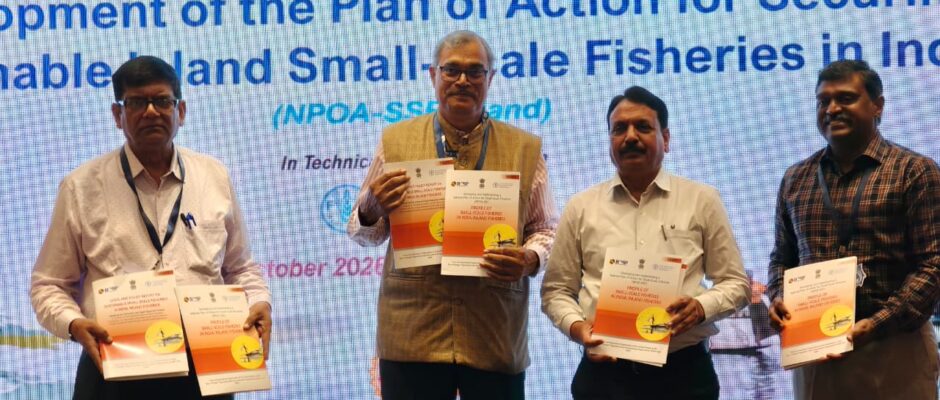
A landmark FAO-BOBP study reveals women make up 44% of India’s 23 million inland fishers, while urging urgent reforms to counter habitat degradation, tenure insecurity, and data blindness. Women represent nearly 44% of India’s 23.12 million inland fishers, yet their contributions remain largely hidden in official records while ecological and institutional pressures mount on freshwater ecosystems. According to a comprehensive country profile prepared by the Bay of Bengal Programme Inter-Governmental Organisation (BOBP-IGO) and the Food and Agriculture Organisation (FAO) of the United Nations, 10.10 million women actively sustain India’s inland small-scale fisheries. Despite this footprint, deep-seated data blind spots, deteriorating aquatic habitats, and insecure tenure rights continue to jeopardize the sector’s long-term viability. The findings were presented in Bhopal, Madhya Pradesh, at the launch workshop for India’s National Plan of Action (NPOA) on Small-Scale Inland Fisheries. Overlooked Labor: Bridging the Gender Data Gap While millions of women handle critical post-harvest processing, retailing, and family-run aquaculture operations, their work is rarely captured in state-level economic assessments. Subsistence harvesting and informal distribution networks are routinely excluded from conventional fisheries statistics. This statistical omission prevents policy interventions, credit programs, and social safety nets from reaching the women who keep local fish supply chains moving. “Better recognition of women’s roles is essential for understanding the sector’s real workforce,” emphasized Dr. P. Krishnan, Director of BOBP-IGO. “Ensuring that fisheries development initiatives adequately reflect the needs and contributions of women is central to building equitable rural economies.” Ecosystem Degradation and Competing Freshwater Demands India’s inland water systems face compounding environmental and anthropogenic threats that disrupt natural fish breeding cycles: Dr. Krishnan noted that protecting these habitats must become an integral component of broader water-security planning, particularly as climate volatility alters regional hydrology. Jurisdictional Overlaps and Insecure Water Tenure Beyond environmental shocks, inland fishers face significant administrative hurdles. Small-scale operators often contend with insecure fishing leases, brief tenure windows, and opaque auction mechanisms that favor commercial contractors over traditional fishing cooperatives. Governance is further complicated by overlapping jurisdictional mandates. A single water body may fall under the competing regulatory purviews of: This institutional fragmentation leaves fisherfolk with weak bargaining power and limited legal recourse when access rights are curtailed. Laying the Groundwork for the National Plan of Action To resolve these systemic bottlenecks, the Department of Fisheries, Government of India, is formulating an overarching National Plan of Action in collaboration with BOBP-IGO and the Government of Madhya Pradesh. With scientific backing from the Indian Council of Agricultural Research (ICAR) fisheries institutes and technical oversight from the FAO, the NPOA aligns India’s domestic fisheries governance with the FAO’s Voluntary Guidelines for Securing Sustainable Small-Scale Fisheries. Establishing fine-grained data collection across individual water bodies, formally recognizing women’s post-harvest labor, and safeguarding traditional water access rights will serve as the three core pillars in transforming India’s inland small-scale fisheries into a resilient, climate-adaptive sector.
Read More

Blue Economy Push: India Targets 30 MT Fish Output and ₹1.25 Lakh Crore Seafood Exports Under New Inland Roadmap

India has initiated a comprehensive national strategy to modernize its freshwater fisheries, rolling out the development phase of the National Plan of Action (NPOA) for inland small-scale fisheries. The initiative underpins an ambitious five-year vision: scaling domestic fish output to 30 million tonnes and driving seafood exports to ₹1.25 lakh crore. Formally launched by Union Fisheries Secretary Dr. Abhilaksh Likhi in Bhopal, the roadmap balances commercial expansion with sustainable freshwater stewardship and livelihood security for artisanal fishing communities. Targets at a Glance Strategic Focus: Livelihoods, Value Chains, and Water Governance The NPOA is designed to address structural bottlenecks across India’s varied inland aquatic landscapes—from river basins and floodplains to reservoirs, lakes, and wetlands. According to Dr. Likhi, the initiative prioritizes three critical areas: Global Alignment and Multi-Stakeholder Roadmap Developed under the guidelines of the United Nations Food and Agriculture Organisation (FAO), the initiative is spearheaded by the Union Department of Fisheries in partnership with the Bay of Bengal Programme Inter-Governmental Organisation (BOBP-IGO). The drafting process will incorporate nationwide stakeholder consultations—engaging state fisheries departments, research institutions, local fishing cooperatives, and community leaders—to ensure that the finalized policy reflects local realities and aligns with international best practices for small-scale fisheries governance.

Read More

The Andhra Shrimp Engine: Inside India’s $2.7 Billion Aquaculture Hub as Cost Pressures and Trade Headwinds Mount

Andhra Pradesh commands nearly 80% of India’s shrimp output and over 32% of its seafood export earnings. But rising feed costs, seed quality risks, and volatile overseas markets now threaten farmer profitability. Andhra Pradesh remains the undisputed heavyweight of Indian aquaculture. Generating nearly a third of India’s farmed fish and four-fifths of its farmed shrimp, the state’s coastal belt forms an export corridor linking remote brackish-water ponds directly to dinner tables across North America, Europe, and Asia. In the 2025–26 fiscal year, Andhra Pradesh exported 4.09 lakh tonnes of marine products valued at ₹23,765.11 crore ($2.72 billion). While the state’s production machinery continues to operate at historic scale, a convergence of domestic cost spikes, biological risks, and shifting dynamics in prime destination markets like the United States is squeezing operating margins down to the farm gate. The Scale: An Economic Powerhouse Along the Bay of Bengal Aquaculture in Andhra Pradesh is not merely an agricultural allied activity; it is an integrated rural-industrial ecosystem sustaining coastal livelihoods across hundreds of hamlets. Export Dominance: Value Disproportion on the National Stage During the 2025–26 financial year, India’s total marine product exports stood at 19.72 lakh tonnes valued at ₹73,890.46 crore ($8.45 billion). Andhra Pradesh’s contribution underscores its role as the nation’s primary foreign-exchange engine in seafood. Metric All-India Total Andhra Pradesh Contribution State Share (%) Export Volume 19,72,018 Tonnes 4,09,274 Tonnes 20.75% Export Value (INR) ₹73,890.46 Crore ₹23,765.11 Crore 32.16% Export Value (USD) $8.45 Billion $2.72 Billion 32.21% Because Andhra Pradesh focuses heavily on premium, export-grade farmed shrimp rather than lower-value marine catches, its value contribution significantly outpaces its volumetric share: more than ₹32 of every ₹100 earned nationally by Indian seafood exports originates in Andhra Pradesh. The state also showed steady year-on-year resilience between 2024–25 and 2025–26: Structural Headwinds Threatening Farmer Viability Behind the record headline numbers lies a deepening crisis of farmer profitability. Small and mid-scale growers face a systemic margin squeeze caused by escalating farm inputs and softening global trade realizations. 1. Surging Feed and Nutrition Costs Feed accounts for 50% to 60% of total operational expenditure in intensive shrimp farming. Global and domestic price surges in core protein ingredients—specifically marine fishmeal, soybean meal, and fish oil—have pushed commercial feed prices to unprecedented highs. Even marginal escalations in feed conversion ratios (FCR) or retail bag prices rapidly eliminate net returns for cultivators. 2. Seed Quality and Disease Vulnerabilities The influx of uncertified or untraceable post-larvae (seed) remains a persistent threat. Substandard seed batches exhibit low survival rates and stunted growth curves. Compounding this is the ongoing threat of aquatic pathogens—including White Spot Syndrome Virus (WSSV), Enterocytozoon hepatopenaei (EHP), and Running Mortality Syndrome (RMS). When outbreaks occur midway through a crop cycle, farmers lose capital already invested in pond preparation, electricity, seed stocking, and weeks of feeding. 3. Market Concentration and Tariff Exposure The United States absorbs a substantial share of Andhra Pradesh’s shrimp exports, leaving the state’s supply chain acutely sensitive to shifting American regulatory and trade measures. Heightened scrutiny around anti-dumping duties, countervailing duties (CVD), and stringent traceability demands have periodically disrupted shipments, forcing exporters to discount inventories or absorb punitive tariffs. 4. Asymmetric Risk Distribution While processing plants and global retail buyers can hedge prices or re-negotiate contracts, primary growers bear the brunt of market volatility. When international prices dip or freight rates surge, farm-gate purchasing rates fall rapidly, frequently forcing farmers to harvest prematurely at sub-optimal counts (sizes) to cut further feeding losses. Sustaining the Edge: What Comes Next? Retaining Andhra Pradesh’s global dominance will require transitioning from pure volume-led production to a model built on biosecurity, input cost rationalization, and value addition. Key interventions being pursued across the sector include stricter state regulation of commercial hatcheries to guarantee disease-free seed, local development of alternative, lower-cost plant- and insect-based feed formulations, and the expansion of domestic value-added processing (such as ready-to-cook and peeled tail-on product lines). Diversifying export destinations across East Asia, the Middle East, and domestic urban centers will also be essential to insulate Andhra Pradesh’s 2.18 lakh farmers from single-market trade shocks.

Read More