

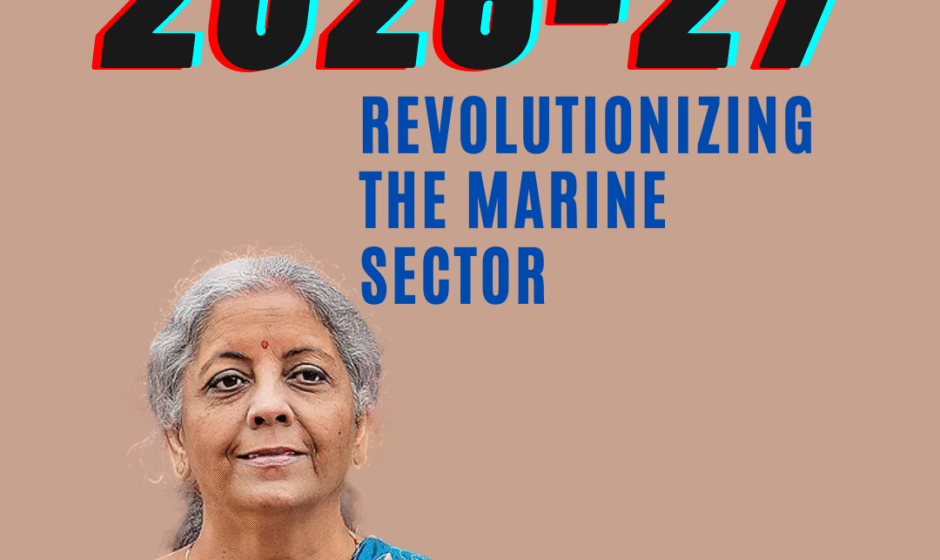

The Union Budget 2026-2027, delivered by Finance Minister Nirmala Sitharaman, represents a structural pivot in the management of India’s marine and blue economy resources. Presented against a backdrop of macroeconomic stability and a projected real GDP growth of $7.4\%$ for the 2025-26 fiscal year, the budget serves as a blueprint for transitioning the fisheries and marine sectors from traditional livelihood activities into professionalized, technology-driven industrial engines. This fiscal framework is grounded in the “3 Kartavya” or duties: the acceleration of sustained economic growth, the fulfillment of citizen aspirations through capacity building, and the realization of inclusive development under the vision of $Sabka$ $Sath,$ $Sabka$ $Vikas$. For the marine industry, this translates into a record-breaking budgetary allocation and a series of aggressive regulatory reforms designed to reclaim India’s economic sovereignty over its Exclusive Economic Zone (EEZ) and the high seas.
I. Macro-Fiscal Framework and Sectoral Allocations
The 2026-27 budget operates within a disciplined fiscal environment, targeting a deficit of $4.3\%$ of GDP, a reduction from the $4.4\%$ revised estimate of the previous year. This fiscal consolidation is intended to reduce the debt-to-GDP ratio from $56.1\%$ to $55.6\%,$ eventually aiming for $50\%$ by 2030. Within this envelope of fiscal prudence, the government has prioritized “allied sectors” of agriculture, recognizing that the $4.6\%$ growth in the primary sector during FY 2025-26 was largely driven by livestock and fisheries rather than traditional crops.
The Ministry of Fisheries, Animal Husbandry and Dairying has received a total allocation of ₹8,915.26 crore, marking a substantial $26.7\%$ increase over the previous year. The Department of Fisheries, specifically, has been granted a total annual budgetary support of ₹2,761.80 crore, the highest ever recorded for the sector. While the departmental hike appears modest at $2\%,$ the internal restructuring of funds—particularly the $66.7\%$ jump in the Pradhan Mantri Matsya Sampada Yojana (PMMSY)—indicates a shift from administrative overhead to direct scheme-based intervention.
| Department / Major Scheme | FY 2025-26 RE (₹ Crore) | FY 2026-27 BE (₹ Crore) | Growth / Shift |
| Ministry Total Allocation | 7,035.00 | 8,915.26 | +26.7% |
| Department of Fisheries (Total) | 2,703.67 | 2,761.80 | +2.1% |
| PM Matsya Sampada Yojana (PMMSY) | 1,500.00 | 2,500.00 | +66.7% |
| Scheme-based Interventions (Total) | 2,420.00 | 2,530.00 | +4.5% |
| Dept. of Animal Husbandry & Dairying | 4,840.40 | 6,153.46 | +27.1% |
| Livestock Health & Disease Control | 1,980.00 | 2,010.00 | +1.5% |
This fiscal strategy acknowledges that the marine industry supports over 50 lakh members of the fishing community across 13 maritime States and Union Territories. By allocating ₹2,530 crore for direct scheme-based interventions, the budget ensures that the majority of resources flow toward primary producers, fish farmers, and coastal infrastructure, rather than being absorbed by institutional bureaucracies.
II. Regulatory Paradigm Shift: Sovereignty in the High Seas
One of the most profound developments in Budget 2026-27 is the legal and regulatory redefinition of India’s maritime economic activity. For decades, Indian fishing vessels operating beyond territorial waters—within the 200 nautical mile Exclusive Economic Zone (EEZ) or on the high seas—faced a paradoxical situation where their catch was frequently treated as an “import” upon returning to Indian shores. This classification attracted customs duties and Integrated Goods and Services Tax (IGST), increasing operational costs and discouraging deep-sea exploration.
Legislative Amendments to the Customs Act
To resolve this long-standing friction, the Finance Minister proposed landmark amendments to the Customs Act, 1962. A new Section 56A is being inserted to provide special provisions for fishing and related activities conducted by Indian-flagged vessels beyond territorial waters. This legislative change is complemented by a new clause in Section 2 of the Act, which provides a formal definition of an “Indian-flagged fishing vessel”.
The implications of these changes are multifaceted:
- Duty-Free Domestic Status: Fish harvested by Indian-flagged vessels in the EEZ or on the high seas can now be brought into India free of duty.
- Export Equivalence: In a move to improve global market access, the budget proposes that the landing of such catch at foreign ports will be treated as an “export of goods”.
- Regulatory Compliance: The government will implement safeguards to prevent the misuse of these provisions during transit or transshipment, requiring vessels to follow specific forms and manners for making entries regarding harvested fish.
- Administrative Oversight: Section 84 of the Customs Act is being amended to empower the Board to make rules for the “custody” of these goods, ensuring a secure and verifiable value chain.
These reforms fundamentally reshape the economic feasibility of deep-sea fishing. By recognizing the EEZ as a domestic economic space, the government is incentivizing the deployment of larger, better-equipped vessels capable of harvesting high-value species such as tuna, marlin, and sailfish. This aligns with the “Blue Economy” vision of fully harnessing the country’s 24 lakh square kilometers of maritime territory.
III. Aquaculture and the Seafood Export Ecosystem
India has emerged as one of the world’s leading aquaculture producers, with shrimp production nearly quadrupling over the past decade. However, the sector has recently faced intense pressure from rising input costs and global trade headwinds, including a slowdown in demand and an effective $50\%$ tariff on Indian shrimp in the United States—a market where India supplies $40\%$ of domestic consumption.
Rationalization of Basic Customs Duty (BCD)
The 2026-27 budget provides immediate relief to aquaculturists by slashing the Basic Customs Duty on critical inputs that are essential for maintaining high yields and meeting international quality standards. The reduction in BCD on fish hydrolysate—a primary protein component in shrimp feed—from $15\%$ to $5\%$ is expected to significantly lower the operational expenses of shrimp farmers.
| Item / Input Category | Previous BCD Rate | New BCD Rate | Strategic Rationale |
| Fish Hydrolysate (Feed component) | 15% | 5% | Lower feed costs for shrimp farmers. |
| Imported Shrimp Broodstock | 30% | 5% | Access to high-quality genetic material. |
| Frozen Fish Paste (Surimi) | 30% | 5% | Boost value-added processing. |
| Seafood Processing Duty-Free Limit | 1% of FOB | 3% of FOB | Enhance global price competitiveness. |
The tripling of the duty-free import limit for specified inputs used in seafood processing (from $1\%$ to $3\%$ of the preceding year’s export turnover) is a vital lever for the industry. This measure allows processing units to source high-end ingredients—such as specialized marinades and breading—without the burden of import duties, directly enhancing the competitiveness of Indian “value-added” seafood products in premium markets like the European Union, Japan, and the UK.
The Role of MPEDA and 2030 Targets
The Marine Products Export Development Authority (MPEDA) has launched a strategic roadmap to double the share of seafood exports by 2030. Currently, value-added seafood accounts for only $10\%$ of India’s total seafood exports ($US\$860$ million), and India controls a mere $2.5\%$ of the global value-added seafood trade. The 2026-27 budget’s duty cuts are designed to facilitate a target of $20\%$ value-added exports by 2030. To support this, MPEDA is conducting nationwide training programs to develop a skilled workforce capable of meeting stringent global food safety and quality standards.
IV. Inland Fisheries and the Reservoir Revolution
While marine fisheries dominate the export narrative, inland fisheries offer vast potential for domestic food security and rural income diversification. India’s inland reservoir network covers approximately 31.5 lakh hectares, yet a lack of organized market linkages has historically limited its productivity.
Integrated Development of 500 Reservoirs
A headline proposal in Budget 2026-27 is the integrated development of 500 reservoirs and Amrit Sarovars (water bodies rejuvenated under the $Azadi$ $ka$ $Amrit$ $Mahotsav$ campaign). The initiative seeks to build a robust inland fisheries value chain by:
- Strengthening Market Linkages: Involving startups and women-led groups alongside Fish Farmer Producer Organizations (FFPOs) to minimize intermediaries.
- Reducing Post-Harvest Losses: Investing in local cold chains and landing centers to ensure that fish catch reaches urban markets in prime condition.
- Cluster-Based Growth: Supporting 34 production and processing clusters designated by the Department of Fisheries to drive efficiencies of scale.
Under Mission Amrit Sarovar, the government has already developed 68,827 sarovars, with 1,222 currently dedicated to fisheries. The budget proposal seeks to scale this success, particularly in coastal areas, to create a diversified protein-rich food supply that is resilient to climate shocks.
V. Blue Infrastructure: Ports, Waterways, and Logistics
The professionalization of the marine industry is contingent upon a world-class logistics infrastructure. The 2026-27 budget continues the massive public investment cycle, raising capital expenditure to ₹12.2 lakh crore.
Operationalization of 20 National Waterways
The government has set an ambitious target to operationalize 20 new National Waterways over the next five years. This begins with National Waterway-5 (NW-5) in Odisha, which is designed to connect mineral-rich regions like Talcher and Angul to the strategic ports of Paradip and Dhamra.
Integral to this infrastructure push is the Coastal Cargo Promotion Scheme, which aims to increase the share of inland waterways and coastal shipping from $6\%$ to $12\%$ by 2047. Complementary measures include:
- Ship Repair Ecosystems: New facilities at Varanasi and Patna to support vessels moving along the Ganga.
- Container Manufacturing: A ₹10,000 crore scheme to boost domestic container production, reducing dependence on global suppliers.
- Seaplane VGF Scheme: A Viability Gap Funding (VGF) scheme to support seaplane operations, improving last-mile connectivity to remote island regions and temple towns like Varanasi and Prayagraj.
City Economic Regions (CER)
The budget proposes mapping “City Economic Regions” based on specific growth drivers, with an allocation of ₹5,000 crore per CER over five years. This model is particularly relevant for port cities, where urban planning can be integrated with industrial clusters and maritime logistics to create globally competitive hubs.
VI. Deep Ocean Mission and Technological Frontiers
India’s scientific ambitions in the marine sector are articulated through the Deep Ocean Mission and the integration of cutting-edge technology into everyday fishing operations.
Deep Ocean Mission (DOM)
The Deep Ocean Mission has been allocated ₹625 crore for 2026-27, a shift from preparatory work to actual hardware realization. The mission’s objectives include:
- Submersible Technology: Developing a manned submersible capable of descending to 6,000 meters.
- Deep-Sea Mining: Creating technologies for mining polymetallic nodules from the ocean floor.
- Bioresource Utilization: Sustainably harvesting deep-sea bioresources for pharmaceuticals and industrial applications.
While the capital expenditure for DOM saw a reduction to ₹175 crore from ₹219.6 crore in the revised estimates, the mission remains a critical component of India’s strategic autonomy in the Indian Ocean.
Satellite-Based Vessel Tracking and AI
The budget places a high premium on the safety and productivity of fishers through digital transformation:
- Bharat-VISTAAR: A multilingual AI-based digital platform designed to provide fishers and farmers with customized digital advisories based on real-time data from AgriStack and ICAR.
- NETRA Satellite Tracking: In collaboration with ISRO, the Department of Fisheries is deploying S-Band satellite terminals on fishing vessels. This solution provides secure, two-way communication beyond the range of mobile networks (100-200 NM) and enables real-time location tracking for search and rescue operations.
- Mission Mausam: With an outlay of ₹1,342 crore, this initiative aims to revolutionize weather monitoring and prediction using high-performance computing, providing critical early warnings for coastal storms and cyclones.
VII. Social Safety Nets and Human Capital
The transition of the fisheries sector requires a parallel investment in the socio-economic welfare of its workers. The 2026-27 budget addresses this through enhanced insurance frameworks and veterinary infrastructure.
Group Accident Insurance Scheme (GAIS)
The Group Accident Insurance Scheme, a sub-component of PMMSY, provides a vital safety net for fishers and workers in the unorganized sector. The scheme is implemented by the National Fisheries Development Board (NFDB) with the premium cost shared entirely between the Central and State Governments, requiring no contribution from the beneficiary.
| Benefit Category | Coverage Amount (₹) | Eligibility / Details |
| Accidental Death | 5,00,000 | Age 18-70; claim within 90 days. |
| Permanent Total Disability | 5,00,000 | Direct cause of injury within 12 months. |
| Permanent Partial Disability | 2,50,000 | Claim settlement within 15 working days. |
| Accidental Hospitalization | 25,000 | Covers treatment and medicines. |
Complementing this, the Pradhan Mantri Matsya Kisan Samridhi Sah-Yojana (PM-MKSSY) provides a one-time incentive for purchasing aquaculture insurance, covering $40\%$ of the premium paid (up to ₹25,000 per hectare). For SC/ST and women beneficiaries, an additional $10\%$ incentive is provided, ensuring that the most disadvantaged groups can de-risk their investments.
Veterinary Infrastructure and Entrepreneurship
Recognizing that animal health is the bedrock of aquaculture productivity, the Finance Minister announced a plan to add over 20,000 veterinary professionals to the workforce. A loan-linked capital subsidy scheme will support the private sector in establishing veterinary colleges, diagnostic laboratories, and breeding facilities. Furthermore, the Kisan Credit Card (KCC) limit for animal husbandry and fisheries has been maintained at ₹5 lakh, ensuring consistent access to working capital.
VIII. Regional Dynamics and Coastal Ecosystems
The impact of the 2026-27 budget is deeply felt at the state level, where local governments are aligning their strategies with national priorities.
The Kerala Fisheries Outlay
The Kerala State Budget for 2026-27 includes a ₹239.12 crore outlay for the fisheries sector. Key focus areas include:
- Punargeham Project: ₹64.20 crore for rehabilitating families affected by sea erosion.
- Marine Safety: ₹2.50 crore for marine ambulances and ₹3 crore for rescue operations.
- Inland Fisheries: ₹70 crore for aquaculture development and ₹30 crore for PMMSY-linked integrated management.
Biodiversity and Tourism in Odisha and Tamil Nadu
In Odisha, the budget supports the development of “turtle trails” along Olive Ridley nesting sites at Gahirmatha Beach and the Rushikulya River mouth, merging marine conservation with biodiversity-led tourism. In Tamil Nadu, the budget targets the modernization of Cuddalore Port and the promotion of high-value coastal crops like coconut and sandalwood. The coconut promotion scheme is specifically designed to replace non-productive trees with improved varieties, directly benefiting nearly 10 million farmers who depend on the crop for their livelihood.
IX. Conclusion: Navigating Global Trade Headwinds
The Union Budget 2026-27 is a sophisticated response to the “slippery global pitch” described by the Finance Minister. By slashing input duties and simplifying customs laws, the government is “counterstriking” against international protectionism while simultaneously building long-term domestic capacity. The transition from traditional crop farming to a professionalized livestock and marine sector is not merely an economic choice but a strategic necessity to ensure the socio-economic welfare of India’s 50 lakh fishers.
The success of these initiatives will hinge on the effective implementation of the “Reforms Express”—particularly the integration of AI-driven advisories, the rollout of satellite-based tracking, and the operationalization of the 20 new National Waterways. As India moves toward hardware realization in the Deep Ocean Mission and doubles down on value-added seafood exports, the 2026-27 budget provides the fiscal and regulatory foundation for the nation to emerge as a global maritime superpower, balancing growth ambitions with environmental stewardship and social inclusion.